Attitude control directly on the rotation group: no Euler-angle singularities, no quaternion ambiguities.
Working directly on the Lie group SO(3) gives attitude controllers that avoid Euler-angle singularities and quaternion ambiguities. I use this to align robots with non-constant 3D vector fields, to extend source seeking to three dimensions, and to build guiding vector fields on the attitude manifold itself.
This paper develops a singularity-free guiding vector field (SF-GVF) for path following on the special orthogonal group SO(3). First, we lift the Euclidean SF-GVF construction to SO(3), integrating the augmented-state approach with the intrinsic Lie-group geometry and obtaining a closed-form geometric guidance law whose integral curves converge to a designer-specified attitude path. The field is defined on a dense open subset of SO(3), excluding only the measure-zero antipodal set — a manifestation of the topological obstruction to continuous global stabilization on SO(3). The construction requires no per-step optimization and produces a control input intrinsically in mathfrakso(3) as body angular rates. Second, we formalize the progression behavior along the path as a designer-supplied function nu(xi), promoting the parametric speed from an implicitly resolved degree of freedom to a first-class design specification. In contrast to the Euclidean condition v = 0, which excludes vehicles with minimum-speed constraints, the corresponding condition omega = 0 on SO(3) is physically admissible for most platforms with active attitude control, making the progression behavior a design freedom structurally available on SO(3) but absent in the Euclidean setting. The framework's structural results are established under a bi-invariant Riemannian metric and hold uniformly across choices of path, progression, and Lyapunov gain. The framework is illustrated in simulation on self-intersecting paths under both constant and point-convergence progression behaviors.
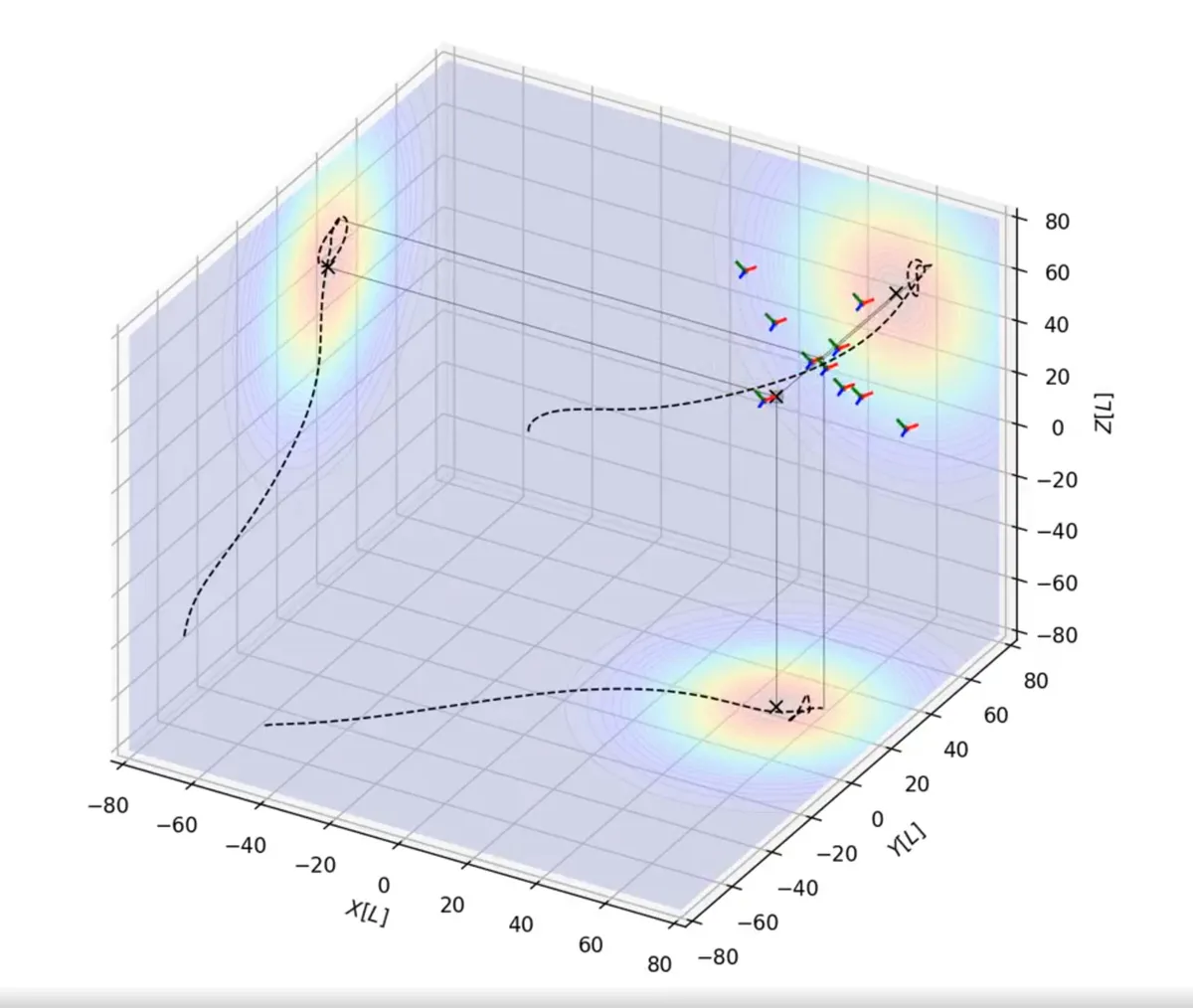
This paper presents a geometric control framework on the Lie group SO(3) for 3D source-seeking by robots with first-order attitude dynamics and constant translational speed. By working directly on SO(3), the approach avoids Euler-angle singularities and quaternion ambiguities, providing a unique, intrinsic representation of orientation. We design a proportional feed-forward controller that ensures exponential alignment of each agent to an estimated ascending direction toward a 3D scalar field source. The controller adapts to bounded unknown variations and preserves well-posed swarm formations. Numerical simulations demonstrate the effectiveness of the method, with all code provided open source for reproducibility.